

The Significance of Hydrangea
These bountiful blooms seem to ebb and flow in popularity, and are currently in vogue. Their large, showy flower-heads are a bouquet in themselves, making them an eye-catching, versatile flower with vintage charm.
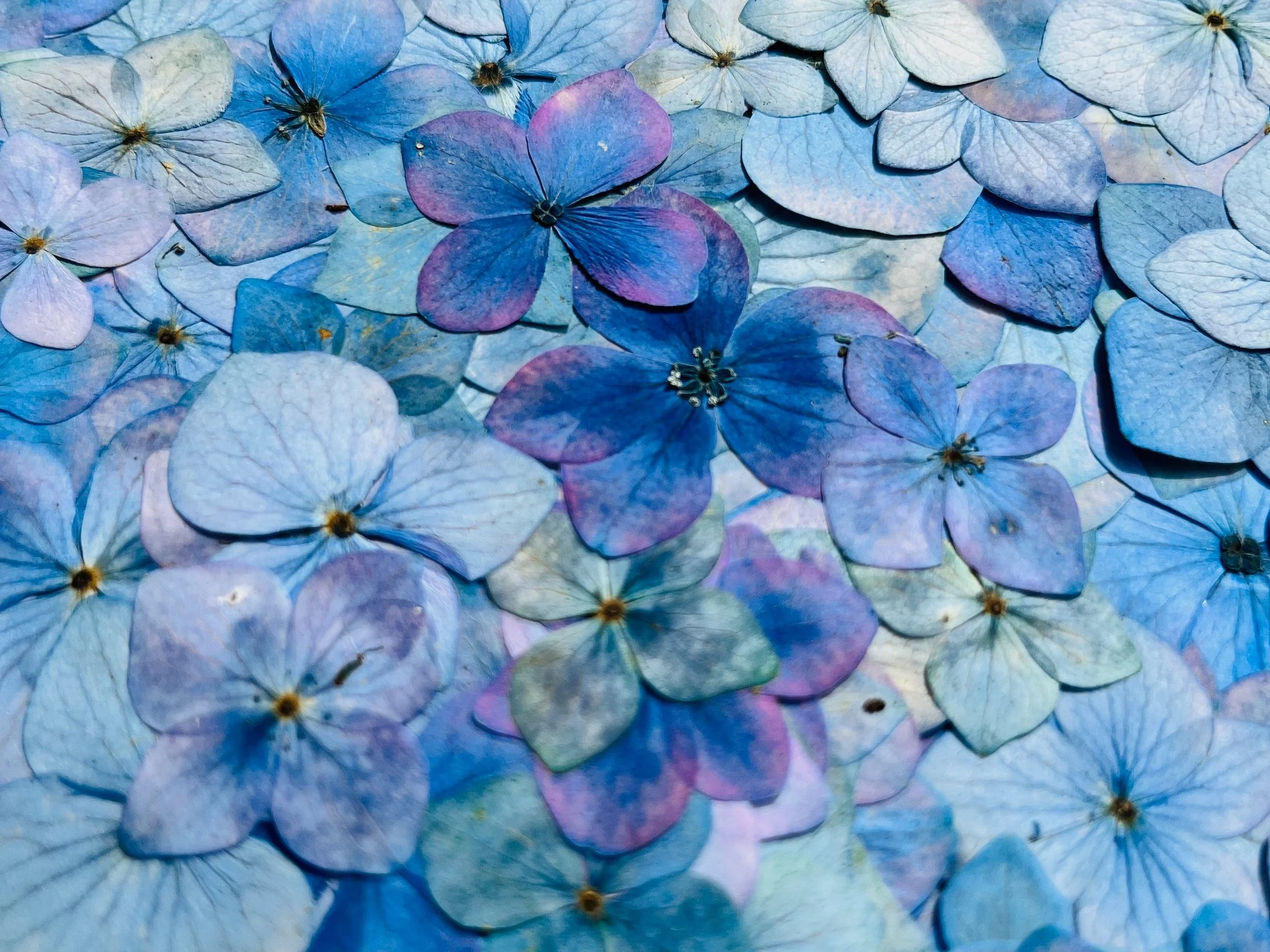
Origins of their name
Though they are native to Asia and America, where they have long significance, the name 'hydrangea’ was given to them in the 18th Century by the botanist Grovonius. The cup shape of the seed capsule reminded him of a water jar, therefore he combined the Greek word ‘hydor’ or ‘hudro’ meaning ‘water’, and ‘angeion’ or ‘angos’ meaning ‘vessel’. As a water-loving plant, this name is quite fitting.
They are also commonly known as Hortensia, from the Latin meaning ‘of the garden’. There’s some uncertainty around why they have also been assigned this name, with references to it being a French or Spanish association.
Symbolic Significance
Hydrangeas have been mentioned in literature as far back as 710AD, depicted in ancient paintings and even discovered as fossils from 40 to 65 million years ago. It’s easy to see that these beloved plants have long reigned in our history as significant.
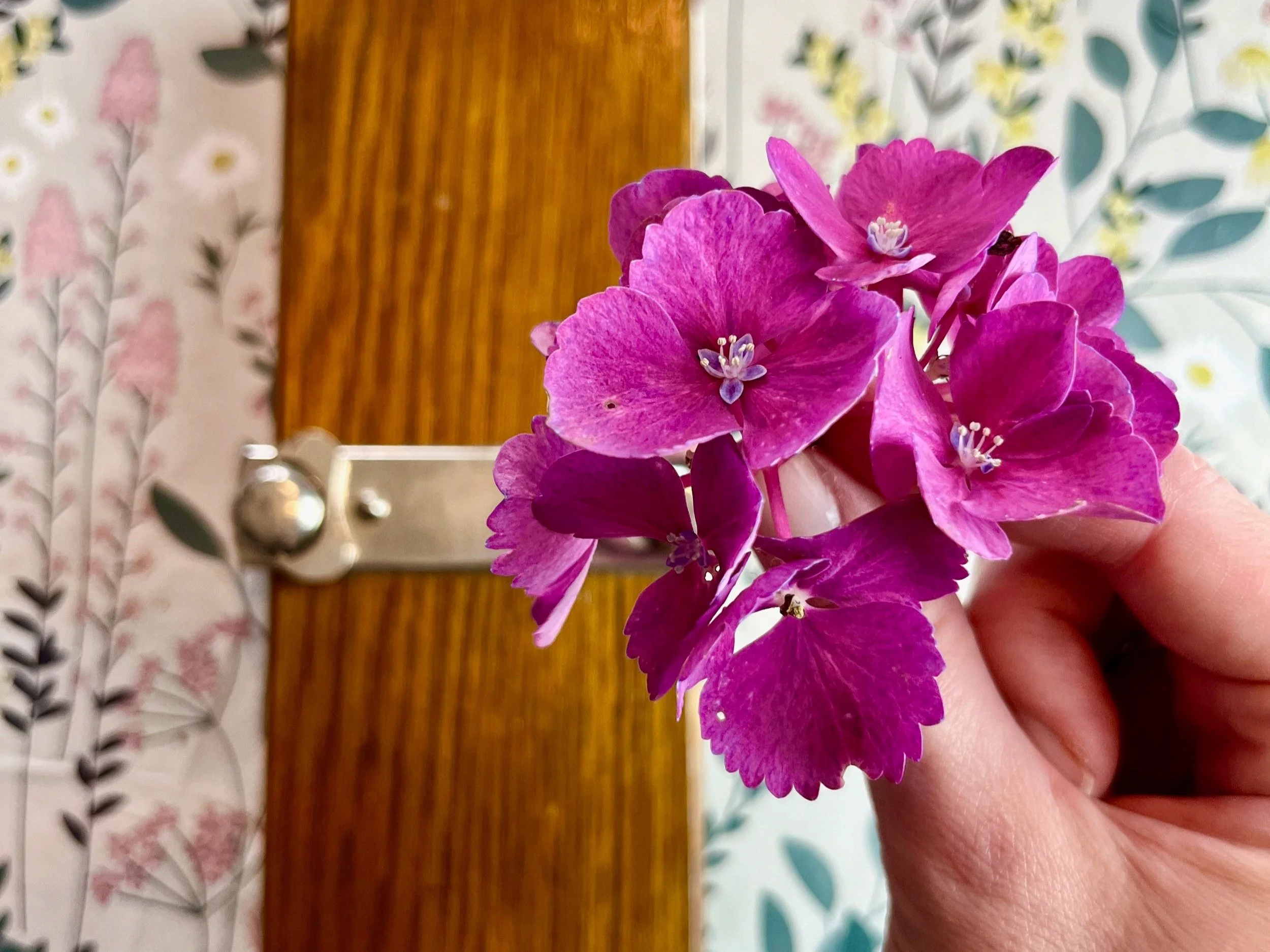
Quite often it is their shape and colour which dominates their significance. An ancient Japanese legend tells of an Emperor who gifted blue hydrangea to the family of the woman who he loved as an apology for neglecting her. In Asia the pink flowers are a representation of the beat of the heart and recognised as a symbol of love and affection. Whereas in European culture these abundant flowers have been associated with vanity and boastfulness. The Victorians, as part of their ‘Language of Flowers’ believed giving hydrangeas was an insult to the receiver; criticising their heartlessness and vanity (James McCabe (2003) The Language and Sentiment of Flowers, Applewood Books).
The colour of flowers continues to hold great significance in modern culture too, and hydrangeas are no exception.
They’ve risen in popularity to decorate wedding ceremonies and bouquets; white often being associated with purity and grace.
Blues continue to represent forgiveness, a heartfelt apology and regret.
For those seeking to make a romantic gesture, pink hydrangeas are perfect for showing sincerity and love.
Those looking to express prosperity, renewal or good fortune, green flowers are an excellent choice.
Purple flowers are often associated with wealth and royalty, but it’s also suggested purple hydrangeas are a wish to get to know someone better too.
Growing Hydrangeas
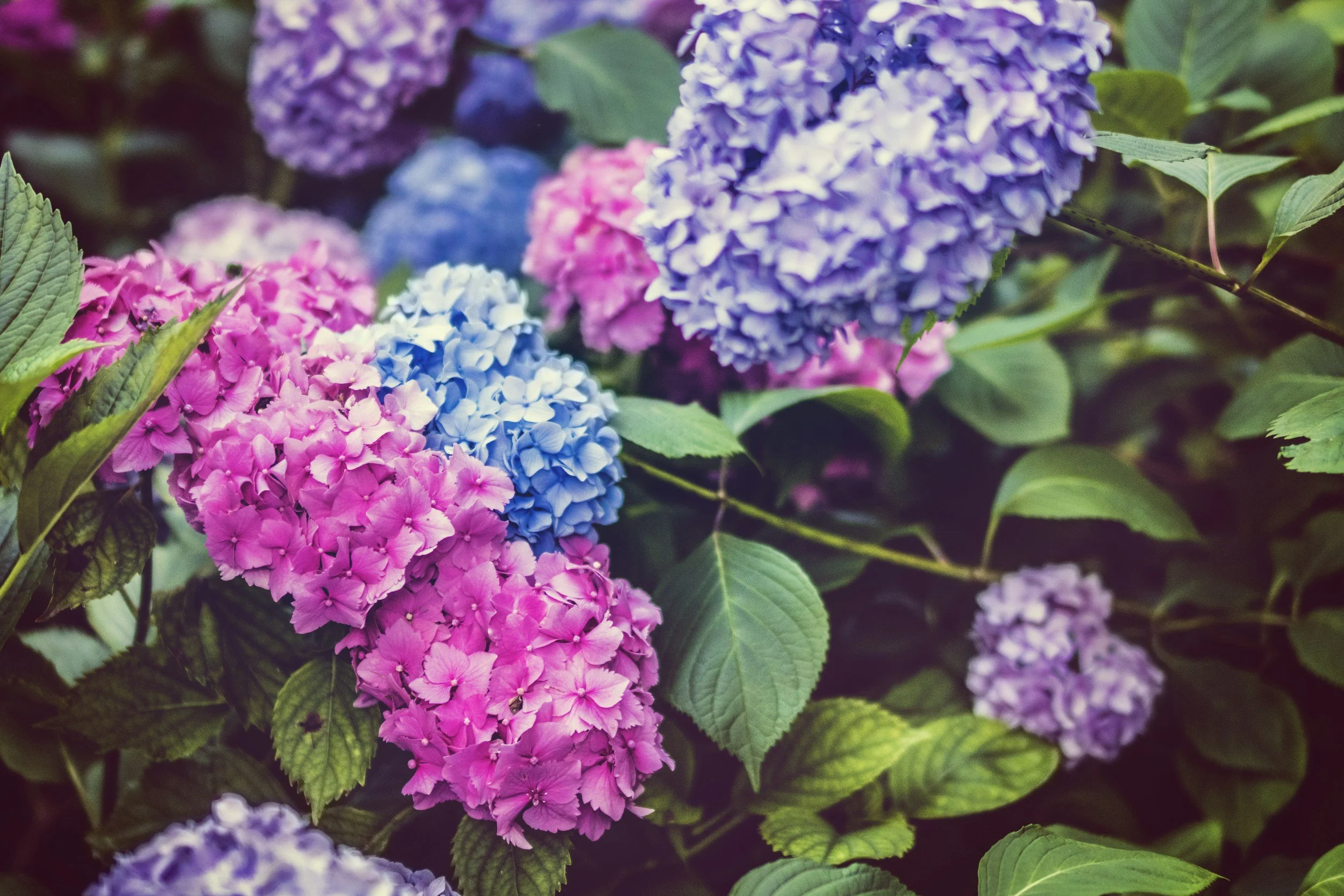
The colour of your hydrangea depends on the PH of the soil. Acidic soil below a PH level of 5.5 will produce blue flowers and that between 5.5 and 6.5 will produce purple flowers. Alkaline soil that is a PH level above 7 will produce pink flowers. With time and patience, you can change the colour of your hydrangea, but this requires some knowledge of your soil and some research.
As well as being a beautiful aesthetic addition to the garden, hydrangeas have other properties and uses, but it’s important to note they are poisonous if ingested. They contain amygdalin, a chemical compound which is released as the toxin cyanide. It’s important to ensure it’s not ingested and is kept away from small children and animals. Despite this, the root of hydrangeas have been used by Native Americans as a diuretic and the bark to treat muscle pain and burns. Hydrangea Serrata has also been brewed as a tea by Japanese Buddhists as part of their cleansing rituals.

Pressing and Drying Hydrangea
Pressing Hydrangea
Hydrangeas are simply perfect for pressing; they’re a great flower for beginner pressers as they press lovely and flat.
Before pressing hydrangea, examine their anatomy. The colourful “petals” are actually sepals or modified leaves which hold and protect the fertile flower in the centre. You can wait for this tiny flower to open before pressing, or leave it closed. I often remove the tiny balled up flower before pressing to achieve a more even press. However, anything you remove from the flower will act as almost an open wound and can lead to browning, particularly from the centre of the pressed flower outwards.
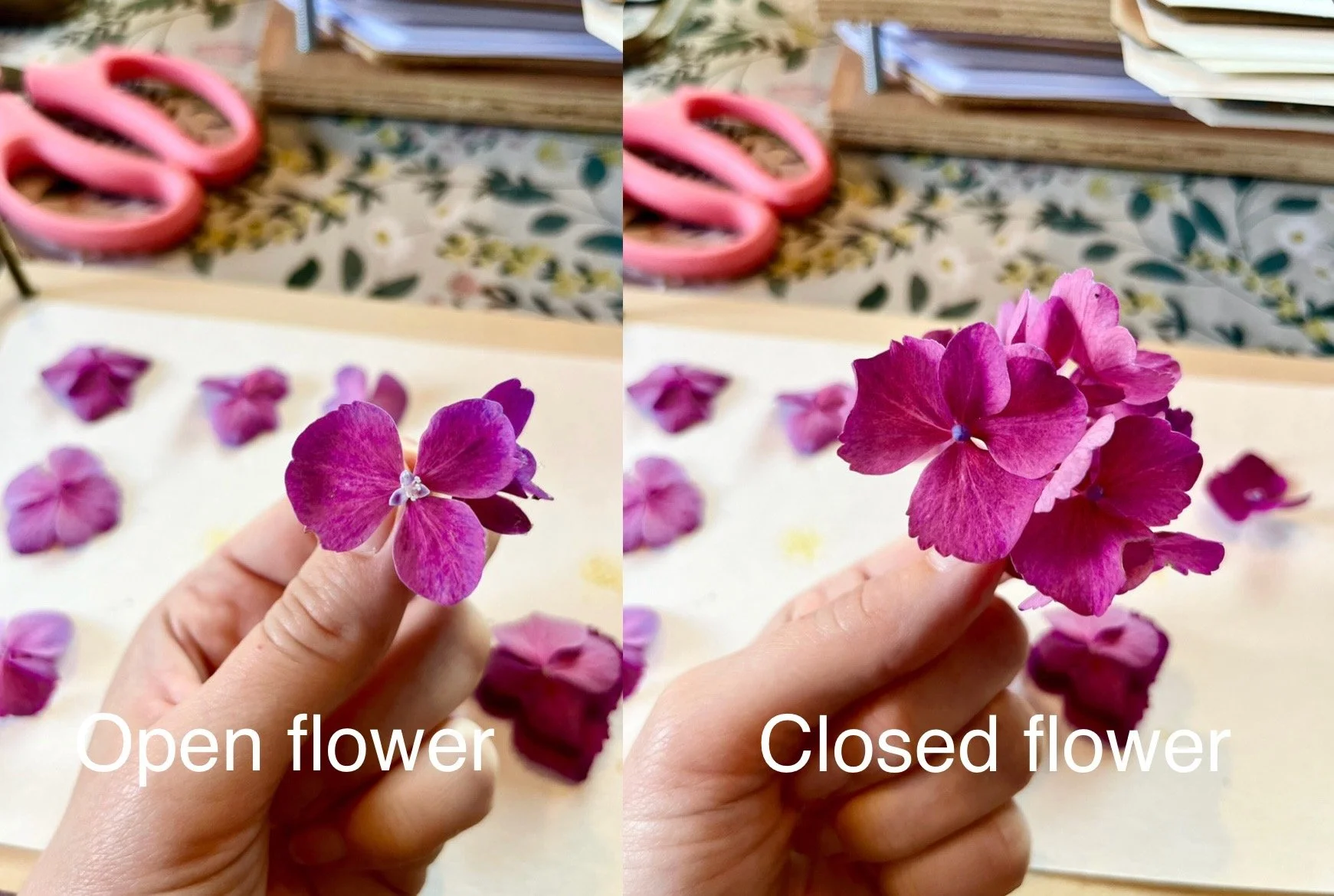
I like to break the larger bushel of hydrangea into smaller, more manageable parts, then snip the flower from each stem right at the base of the sepals.
Once this is done, I then remove the tiny balled up flowers in the centre, or leave them if they’re open.
Place them face-down on the page with plenty of space around them so the moisture can escape into the papers.
Despite hydrangea flowers being very thin, it’s still important to check on them regularly. I always change out the papers every day for the first few days. If it’s warm and dry, they’ll dry out much more quickly (sometimes in as little as a week!) than when it is humid or cold. On average, I always leave flowers to press for at least two weeks before removing them, even if they’re starting to feel dry.
Hydrangeas have a habit of sticking to your pages, therefore to reduce disturbing them during paper changes, leave them on the two pages they’re sandwiched between and change out the papers around them. When removing them from the page, once they’re completely dry, bend the page slightly to encourage the edge of the colourful sepals to pull away from the page, then pop it off the page.
I’d recommend storing your pressed hydrangeas between two pages of paper inside a plastic wallet (also known as a punched pocket or polypropylene). If you stack them in a drawer their edges are likely to curl and they’ll become deformed.
TOP TIP:
If you’re unsure whether your flower is completely dry, try running it along your top lip, which is much more sensitive and can detect levels of moisture more efficiently than your fingers.
If you’ve enjoyed this blog, you can support my work here - thank you!
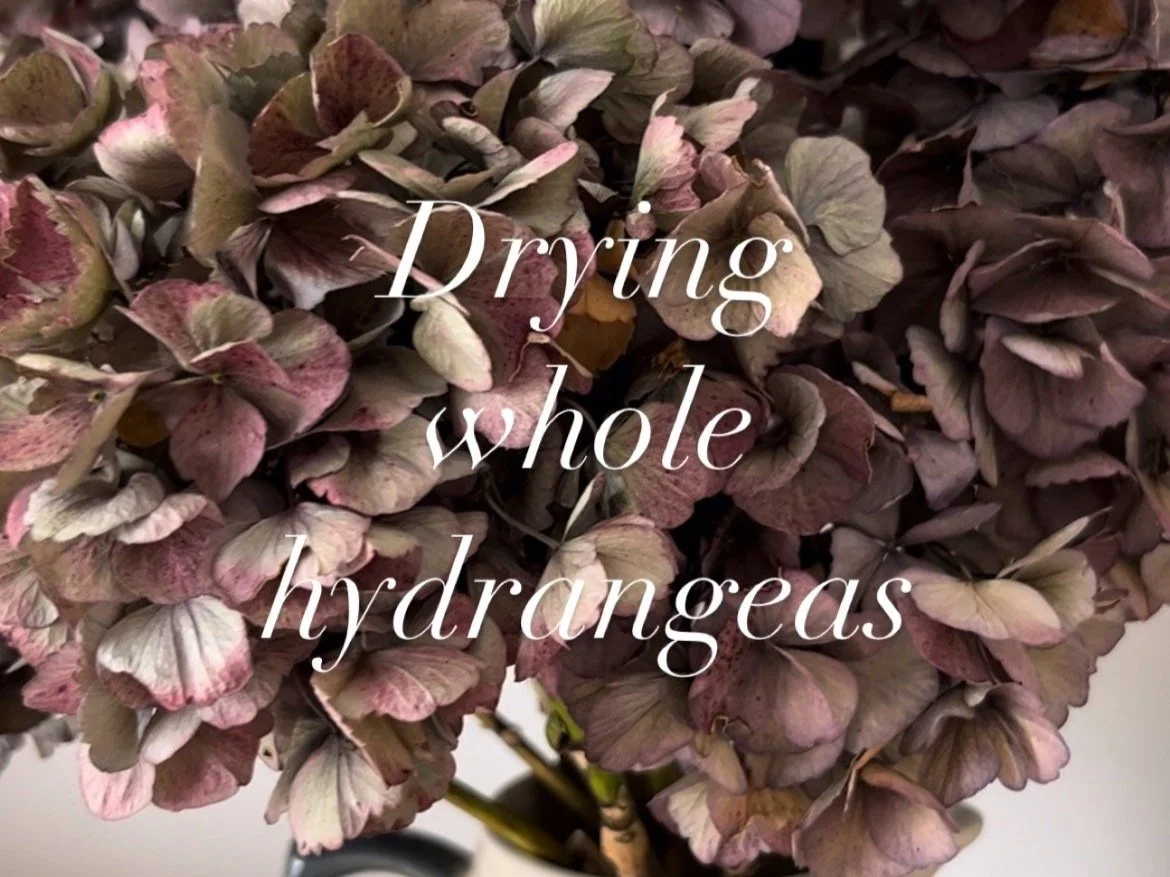
Drying whole hydrangea
There’s a short video on how I dry my hydrangeas whole. It’s available to Instagram Subscribers on the exclusive subscriber grid. Here you can gain more insights and tips on pressing a variety of flowers, including behind-the-scenes resin art too.
To Learn More about how to press flowers and achieve consistent and beautiful results, explore our online courses and helpful guidebooks.
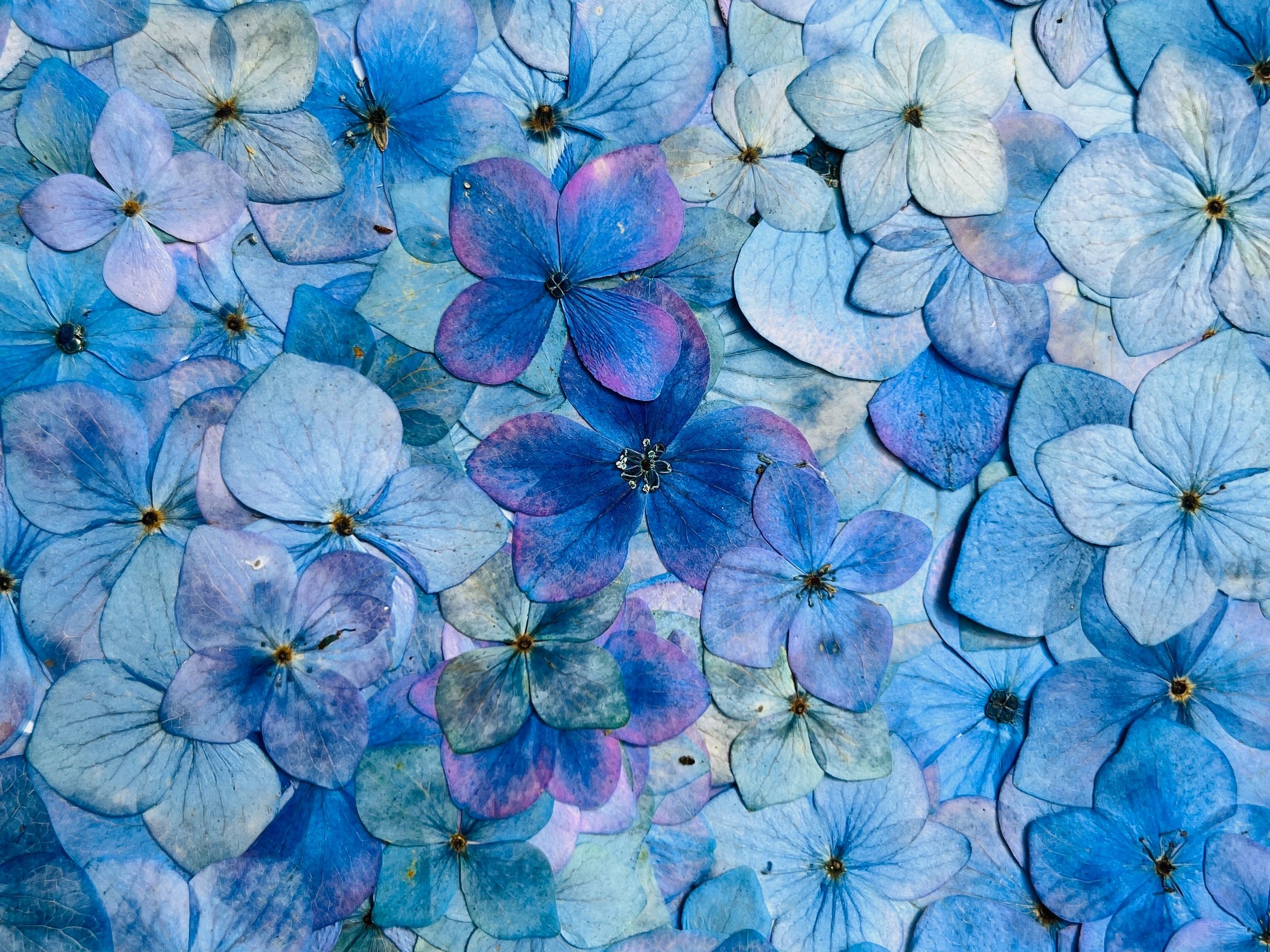
Learn more about the beautiful art of flower pressing
